what to dou call it when two chromosomes share

Crossing over occurs between prophase I and metaphase I and is the process where two homologous non-sister chromatids pair upward with each other and substitution unlike segments of genetic fabric to form ii recombinant chromosome sister chromatids. It tin as well happen during mitotic division,[one] which may result in loss of heterozygosity. Crossing over is important for the normal segregation of chromosomes during meiosis.[two] Crossing over also accounts for genetic variation, because due to the swapping of genetic material during crossing over, the chromatids held together by the centromere are no longer identical. Then, when the chromosomes go on to meiosis II and separate, some of the girl cells receive daughter chromosomes with recombined alleles. Due to this genetic recombination, the offspring have a different set of alleles and genes than their parents do. In the diagram, genes B and b are crossed over with each other, making the resulting recombinants after meiosis Ab, AB, ab, and aB.

Thomas Hunt Morgan'due south illustration of crossing over (1916)

Chromosomal crossover, or crossing over, is the exchange of genetic material during sexual reproduction between two homologous chromosomes' non-sister chromatids that results in recombinant chromosomes. It is one of the last phases of genetic recombination, which occurs in the pachytene stage of prophase I of meiosis during a process called synapsis. Synapsis begins before the synaptonemal circuitous develops and is non completed until most the terminate of prophase I. Crossover usually occurs when matching regions on matching chromosomes intermission and and then reconnect to the other chromosome.
Crossing over is described, in theory, by Thomas Hunt Morgan. He relied on the discovery of Frans Alfons Janssens who described the phenomenon in 1909 and had called it "chiasmatypie".[3] The term chiasma is linked, if non identical, to chromosomal crossover. Morgan immediately saw the great importance of Janssens' cytological interpretation of chiasmata to the experimental results of his inquiry on the heredity of Drosophila. The physical basis of crossing over was first demonstrated past Harriet Creighton and Barbara McClintock in 1931.[4]
The linked frequency of crossing over between two gene loci (markers) is the crossing-over value . For fixed set of genetic and ecology conditions, recombination in a particular region of a linkage structure (chromosome) tends to be constant and the aforementioned is then truthful for the crossing-over value which is used in the production of genetic maps.[5] [vi]
Origins [edit]
There are two popular and overlapping theories that explain the origins of crossing-over, coming from the dissimilar theories on the origin of meiosis. The first theory rests upon the idea that meiosis evolved as another method of Dna repair, and thus crossing-over is a novel manner to replace perchance damaged sections of DNA.[ citation needed ] The second theory comes from the idea that meiosis evolved from bacterial transformation, with the function of propagating diversity.[7] In 1931, Barbara McClintock discovered a triploid maize plant. She fabricated key findings regarding corn'due south karyotype, including the size and shape of the chromosomes. McClintock used the prophase and metaphase stages of mitosis to depict the morphology of corn's chromosomes, and later on showed the showtime ever cytological demonstration of crossing over in meiosis. Working with student Harriet Creighton, McClintock also fabricated pregnant contributions to the early agreement of codependency of linked genes.
DNA repair theory [edit]
Crossing over and DNA repair are very similar processes, which utilize many of the aforementioned protein complexes.[8] [ix] In her written report, "The Significance of Responses of the Genome to Challenge", McClintock studied corn to show how corn's genome would change itself to overcome threats to its survival. She used 450 cocky-pollinated plants that received from each parent a chromosome with a ruptured terminate. She used modified patterns of gene expression on dissimilar sectors of leaves of her corn plants to prove that transposable elements ("controlling elements") hide in the genome, and their mobility allows them to change the action of genes at different loci. These elements can besides restructure the genome, anywhere from a few nucleotides to whole segments of chromosome. Recombinases and primases lay a foundation of nucleotides along the DNA sequence. One such detail protein circuitous that is conserved between processes is RAD51, a well conserved recombinase protein that has been shown to be crucial in Deoxyribonucleic acid repair every bit well as cross over.[ten] Several other genes in D. melanogaster accept been linked besides to both processes, by showing that mutants at these specific loci cannot undergo DNA repair or crossing over. Such genes include mei-41, mei-9, hdm, spnA, and brca2.[ citation needed ] This large group of conserved genes between processes supports the theory of a close evolutionary relationship. Furthermore, Dna repair and crossover accept been found to favor similar regions on chromosomes. In an experiment using radiation hybrid mapping on wheat'south (Triticum aestivum L.) 3B chromosome, crossing over and DNA repair were institute to occur predominantly in the aforementioned regions.[xi] Furthermore, crossing over has been correlated to occur in response to stressful, and likely Dna damaging, conditions [12] [13]
Links to bacterial transformation [edit]
The procedure of bacterial transformation also shares many similarities with chromosomal cross over, particularly in the formation of overhangs on the sides of the broken Dna strand, allowing for the annealing of a new strand. Bacterial transformation itself has been linked to Dna repair many times.[ citation needed ] The 2nd theory comes from the idea that meiosis evolved from bacterial transformation, with the function of propagating genetic diversity.[7] [14] Thus, this evidence suggests that it is a question of whether cross over is linked to DNA repair or bacterial transformation, as the two do not appear to be mutually sectional. It is likely that crossing over may take evolved from bacterial transformation, which in turn developed from Dna repair, thus explaining the links betwixt all three processes.
Chemical science [edit]
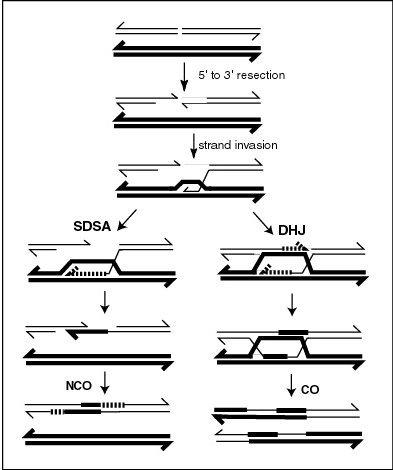
A current model of meiotic recombination, initiated by a double-strand suspension or gap, followed by pairing with a homologous chromosome and strand invasion to initiate the recombinational repair process. Repair of the gap tin lead to crossover (CO) or non-crossover (NCO) of the flanking regions. CO recombination is thought to occur by the Double Holliday Junction (DHJ) model, illustrated on the correct, above. NCO recombinants are thought to occur primarily by the Synthesis Dependent Strand Annealing (SDSA) model, illustrated on the left, higher up. Near recombination events appear to exist the SDSA blazon.
Meiotic recombination may be initiated by double-stranded breaks that are introduced into the DNA by exposure to Deoxyribonucleic acid damaging agents,[ citation needed ] or the Spo11 protein.[xv] One or more exonucleases then digest the 5' ends generated by the double-stranded breaks to produce three' single-stranded DNA tails (see diagram). The meiosis-specific recombinase Dmc1 and the general recombinase Rad51 coat the single-stranded DNA to course nucleoprotein filaments.[16] The recombinases catalyze invasion of the contrary chromatid past the single-stranded DNA from 1 end of the break. Adjacent, the 3' stop of the invading DNA primes DNA synthesis, causing displacement of the complementary strand, which afterwards anneals to the single-stranded Deoxyribonucleic acid generated from the other end of the initial double-stranded break. The structure that results is a cantankerous-strand exchange, also known every bit a Holliday junction. The contact between ii chromatids that will soon undergo crossing-over is known as a chiasma. The Holliday junction is a tetrahedral structure which can be 'pulled' by other recombinases, moving it forth the four-stranded structure.
-

Holliday Junction
-

Molecular structure of a Holliday junction.
-

Molecular construction of a Holliday junction. From PDB: 3CRX.
MSH4 and MSH5 [edit]
The MSH4 and MSH5 proteins course a hetero-oligomeric structure (heterodimer) in yeast and humans.[17] [18] [19] In the yeast Saccharomyces cerevisiae MSH4 and MSH5 deed specifically to facilitate crossovers between homologous chromosomes during meiosis.[17] The MSH4/MSH5 circuitous binds and stabilizes double Holliday junctions and promotes their resolution into crossover products. An MSH4 hypomorphic (partially functional) mutant of Due south. cerevisiae showed a xxx% genome broad reduction in crossover numbers, and a large number of meioses with not substitution chromosomes.[20] Nevertheless, this mutant gave rise to spore viability patterns suggesting that segregation of non-exchange chromosomes occurred efficiently. Thus in S. cerevisiae proper segregation obviously does non entirely depend on crossovers between homologous pairs.
Chiasma [edit]
The grasshopper Melanoplus femur-rubrum was exposed to an astute dose of 10-rays during each private phase of meiosis, and chiasma frequency was measured.[21] Irradiation during the leptotene-zygotene stages of meiosis (that is, prior to the pachytene menses in which crossover recombination occurs) was found to increment subsequent chiasma frequency. Similarly, in the grasshopper Chorthippus brunneus, exposure to Ten-irradiation during the zygotene-early pachytene stages acquired a pregnant increase in mean prison cell chiasma frequency.[22] Chiasma frequency was scored at the later diplotene-diakinesis stages of meiosis. These results advise that Ten-rays induce DNA damages that are repaired past a crossover pathway leading to chiasma formation.
Class I and class Two crossovers [edit]
Double strand breaks (DSBs) are repaired past ii pathways to generate crossovers in eukaryotes.[23] The majority of them are repaired by MutL homologs MLH1 and MLH3, which defines the form I crossovers. The remaining are the result of the grade 2 pathway, which is regulated by MUS81 endonuclease. In that location are interconnections between these two pathways—grade I crossovers can compensate for the loss of course 2 pathway. In MUS81 knockout mice, course I crossovers are elevated, while full crossover counts at chiasmata are normal. However, the mechanisms underlining this crosstalk are not well understood. A recent report suggests that a scaffold poly peptide called SLX4 may participate in this regulation.[24] Specifically, SLX4 knockout mice largely phenocopies the MUS81 knockout—once again, an elevated course I crossovers while normal chiasmata count.
Consequences [edit]

In near eukaryotes, a jail cell carries two versions of each gene, each referred to as an allele. Each parent passes on one allele to each offspring. An private gamete inherits a complete haploid complement of alleles on chromosomes that are independently selected from each pair of chromatids lined up on the metaphase plate. Without recombination, all alleles for those genes linked together on the same chromosome would be inherited together. Meiotic recombination allows a more contained segregation betwixt the two alleles that occupy the positions of single genes, as recombination shuffles the allele content between homologous chromosomes.
Recombination results in a new arrangement of maternal and paternal alleles on the same chromosome. Although the same genes announced in the same order, some alleles are unlike. In this way, it is theoretically possible to accept any combination of parental alleles in an offspring, and the fact that 2 alleles appear together in one offspring does non have any influence on the statistical probability that another offspring will have the same combination. This principle of "contained assortment" of genes is fundamental to genetic inheritance.[25] However, the frequency of recombination is really not the same for all cistron combinations. This leads to the notion of "genetic altitude", which is a measure out of recombination frequency averaged over a (suitably large) sample of pedigrees. Loosely speaking, 1 may say that this is considering recombination is profoundly influenced by the proximity of one gene to another. If 2 genes are located close together on a chromosome, the likelihood that a recombination event volition separate these ii genes is less than if they were farther apart. Genetic linkage describes the tendency of genes to be inherited together as a result of their location on the same chromosome. Linkage disequilibrium describes a situation in which some combinations of genes or genetic markers occur more than or less often in a population than would be expected from their distances apart. This concept is applied when searching for a gene that may cause a particular disease. This is done by comparing the occurrence of a specific DNA sequence with the appearance of a illness. When a high correlation between the ii is constitute, it is probable that the appropriate factor sequence is really closer.[26]
Non-homologous crossover [edit]
Crossovers typically occur between homologous regions of matching chromosomes, but similarities in sequence and other factors can result in mismatched alignments. Most DNA is composed of base of operations pair sequences repeated very large numbers of times.[27] These repetitious segments, often referred to every bit satellites, are fairly homogenous among a species.[27] During Dna replication, each strand of Dna is used every bit a template for the creation of new strands using a partially-conserved mechanism; proper functioning of this procedure results in 2 identical, paired chromosomes, often called sisters. Sister chromatid crossover events are known to occur at a rate of several crossover events per cell per division in eukaryotes.[27] Near of these events involve an exchange of equal amounts of genetic data, just diff exchanges may occur due to sequence mismatch. These are referred to past a variety of names, including non-homologous crossover, diff crossover, and unbalanced recombination, and result in an insertion or deletion of genetic information into the chromosome. While rare compared to homologous crossover events, these mutations are drastic, affecting many loci at the same time. They are considered the chief driver behind the generation of factor duplications and are a general source of mutation within the genome.[28]
The specific causes of non-homologous crossover events are unknown, only several influential factors are known to increase the likelihood of an unequal crossover. One common vector leading to unbalanced recombination is the repair of double-strand breaks (DSBs).[29] DSBs are often repaired using homology directed repair, a process which involves invasion of a template strand past the DSB strand (meet figure beneath). Nearby homologous regions of the template strand are ofttimes used for repair, which can give rise to either insertions or deletions in the genome if a non-homologous just complementary function of the template strand is used.[29] Sequence similarity is a major player in crossover – crossover events are more likely to occur in long regions of close identity on a gene.[30] This means that any department of the genome with long sections of repetitive Deoxyribonucleic acid is decumbent to crossover events.
The presence of transposable elements is another influential element of non-homologous crossover. Repetitive regions of code characterize transposable elements; complementary but non-homologous regions are ubiquitous within transposons. Because chromosomal regions composed of transposons accept large quantities of identical, repetitious lawmaking in a condensed infinite, it is idea that transposon regions undergoing a crossover issue are more than prone to erroneous complementary match-up;[31] that is to say, a section of a chromosome containing a lot of identical sequences, should it undergo a crossover consequence, is less certain to match upwardly with a perfectly homologous section of complementary code and more prone to bounden with a section of code on a slightly dissimilar role of the chromosome. This results in unbalanced recombination, equally genetic information may be either inserted or deleted into the new chromosome, depending on where the recombination occurred.
While the motivating factors behind diff recombination remain obscure, elements of the physical mechanism have been elucidated. Mismatch repair (MMR) proteins, for instance, are a well-known regulatory family of proteins, responsible for regulating mismatched sequences of DNA during replication and escape regulation.[32] The operative goal of MMRs is the restoration of the parental genotype. One class of MMR in particular, MutSβ, is known to initiate the correction of insertion-deletion mismatches of upwards to sixteen nucleotides.[32] Little is known about the excision process in eukaryotes, but E. coli excisions involve the cleaving of a nick on either the 5' or 3' strand, later on which Dna helicase and DNA polymerase III demark and generate single-stranded proteins, which are digested by exonucleases and fastened to the strand by ligase.[32] Multiple MMR pathways take been implicated in the maintenance of complex organism genome stability, and any of many possible malfunctions in the MMR pathway result in DNA editing and correction errors.[33] Therefore, while it is not certain precisely what mechanisms lead to errors of non-homologous crossover, it is extremely likely that the MMR pathway is involved.
See also [edit]
- Diff crossing over
- Coefficient of coincidence
- Genetic distance
- Independent assortment
- Mitotic crossover
- Recombinant frequency
References [edit]
- ^ Griffiths, AJF; Gelbart, WM; Miller, JH; et al. (1999). "Mod Genetic Assay: Mitotic Crossing-Over". Mod Genetic Analysis. New York: Westward. H. Freeman.
- ^ Wang, Shunxin; Zickler, Denise; Kleckner, Nancy; Zhang, Liangran (1 February 2015). "Meiotic crossover patterns: Obligatory crossover, interference and homeostasis in a single process". Prison cell Bike. 14 (3): 305–314. doi:10.4161/15384101.2014.991185. ISSN 1538-4101. PMC4353236. PMID 25590558.
- ^ Janssens, F. A.; Koszul, Romain; Zickler, Denise (June 2012). "La Theorie de la Chiasmatypie". Genetics. 191 (2): 319–346. doi:10.1534/genetics.112.139725. ISSN 0016-6731. PMC3374304. PMID 22701051.
- ^ Creighton H, McClintock B (1931). "A Correlation of Cytological and Genetical Crossing-Over in Zea Mays". Proc Natl Acad Sci USA. 17 (8): 492–7. Bibcode:1931PNAS...17..492C. doi:10.1073/pnas.17.8.492. PMC1076098. PMID 16587654. (Original paper)
- ^ Rieger R. Michaelis A., Green Thousand. Yard. (1976). Glossary of genetics and cytogenetics: Classical and molecular. Heidelberg – New York: Springer-Verlag. ISBN978-3-540-07668-1.
{{cite volume}}: CS1 maint: uses authors parameter (link) - ^ King R. C., Stransfield West. D. (1998): Dictionary of genetics. Oxford University Printing, New York, Oxford, ISBN 0-19-50944-1-vii; ISBN 0-nineteen-509442-5.
- ^ a b Bernstein, H; Bernstein, C (2010). "Evolutionary origin of recombination during meiosis". BioScience. sixty (vii): 498–505. doi:10.1525/bio.2010.60.7.5. S2CID 86663600.
- ^ Dangel, NJ; Knoll, A; Puchta, H (2014). "MHF1 plays Fanconi anaemia complementation group M poly peptide (FANCM)-dependent and FANCM-contained roles in Deoxyribonucleic acid repair and homologous recombination in plants". Plant J. 78 (five): 822–33. doi:x.1111/tpj.12507. PMID 24635147.
- ^ Saponaro, M; Callahan, D; Zheng, Ten; Liberi, G (2010). "Cdk1 Targets Srs2 to Consummate Synthesis-Dependent Strand Annealing and to Promote Recombinational Repair". PLOS Genet. 6 (ii): e1000858. doi:10.1371/periodical.pgen.1000858. PMC2829061. PMID 20195513.
- ^ Esposito, M (September 1978). "Testify that Spontaneous Mitotic Recombination Occurs at the Ii-Strand Stage". Proceedings of the National University of Sciences of the USA. 75 (ix): 4436–4440. Bibcode:1978PNAS...75.4436E. doi:10.1073/pnas.75.9.4436. PMC336130. PMID 360220.
- ^ Kumar, A; Bassi, F; Paux, E (2012). "DNA repair and crossing over favor similar chromosome regions as discovered in radiation hybrid of Triticum". BMC Genomics. 13 (339): 339. doi:10.1186/1471-2164-xiii-339. PMC3443642. PMID 22827734.
- ^ Steinboeck, F (2010). "The relevance of oxidative stress and cytotoxic DNA lesions for spontaneous mutagenesis in not-replicating yeast cells". Mutat Res. 688 (1–2): 47–52. doi:ten.1016/j.mrfmmm.2010.03.006. PMID 20223252.
- ^ Nedelcu, Yard; Marcu, O; Michod, RE (2004). "Sex activity as a response to oxidative stress: a twofold increase in cellular reactive oxygen species activates sex genes". Proc. R. Soc. B. 271 (1548): 1591–1596. doi:10.1098/rspb.2004.2747. PMC1691771. PMID 15306305.
- ^ Charpentier, 10 (2010). "Antibiotics and UV Radiation Induce Competence for Natural Transformation in Legionella pneumophila". Journal of Bacteriology. 193 (5): 1114–1121. doi:ten.1128/JB.01146-10. PMC3067580. PMID 21169481.
- ^ Keeney, Due south; Giroux, CN; Kleckner, North (1997). "Meiosis-Specific Deoxyribonucleic acid Double-Strand Breaks Are Catalyzed by Spo11, a Member of a Widely Conserved Protein Family". Cell. 88 (iii): 375–84. doi:10.1016/S0092-8674(00)81876-0. PMID 9039264. S2CID 8294596.
- ^ Sauvageau, S; Stasiak, Az; Banville, I; Ploquin, Grand; Stasiak, A; Masson, Jy (June 2005). "Fission Yeast Rad51 and Dmc1, Two Efficient Deoxyribonucleic acid Recombinases Forming Helical Nucleoprotein Filaments". Molecular and Cellular Biology. 25 (eleven): 4377–87. doi:10.1128/MCB.25.xi.4377-4387.2005. ISSN 0270-7306. PMC1140613. PMID 15899844.
- ^ a b Pochart P, Woltering D, Hollingsworth NM (1997). "Conserved properties between functionally distinct MutS homologs in yeast". J. Biol. Chem. 272 (48): 30345–9. doi:10.1074/jbc.272.48.30345. PMID 9374523.
- ^ Winand NJ, Panzer JA, Kolodner RD (1998). "Cloning and label of the human and Caenorhabditis elegans homologs of the Saccharomyces cerevisiae MSH5 gene". Genomics. 53 (1): 69–eighty. doi:10.1006/geno.1998.5447. PMID 9787078.
- ^ Bocker T, Barusevicius A, Snowden T, Rasio D, Guerrette S, Robbins D, Schmidt C, Burczak J, Croce CM, Copeland T, Kovatich AJ, Fishel R (1999). "hMSH5: a human MutS homologue that forms a novel heterodimer with hMSH4 and is expressed during spermatogenesis". Cancer Res. 59 (4): 816–22. PMID 10029069.
- ^ Krishnaprasad GN, Anand MT, Lin M, Tekkedil MM, Steinmetz LM, Nishant KT (2015). "Variation in crossover frequencies perturb crossover assurance without affecting meiotic chromosome segregation in Saccharomyces cerevisiae". Genetics. 199 (2): 399–412. doi:10.1534/genetics.114.172320. PMC4317650. PMID 25467183.
- ^ Church 1000, Wimber DE (1969). "Meiosis in the grasshopper: chiasma frequency after elevated temperature and x-rays". Can. J. Genet. Cytol. 11 (ane): 209–16. doi:10.1139/g69-025. PMID 5797806.
- ^ Westerman M (1971). "The effect of x-irradiation on chiasma frequency in Chorthippus brunneus". Heredity. 27 (1): 83–91. doi:10.1038/hdy.1971.73. PMID 5289295.
- ^ Holloway, J. K., Booth, J., Edelmann, Due west., McGowan, C. H., & Cohen, P. Eastward. (2008). MUS81 generates a subset of MLH1-MLH3-independent crossovers in mammalian meiosis. PLoS genetics, 4(9), e1000186. https://doi.org/x.1371/journal.pgen.1000186
- ^ Holloway, J. K., Mohan, South., Balmus, 1000., Lord's day, X., Modzelewski, A., Borst, P. L., Freire, R., Weiss, R. Due south., & Cohen, P. E. (2011). Mammalian BTBD12 (SLX4) protects against genomic instability during mammalian spermatogenesis. PLoS Genetics, 7(vi). https://doi.org/10.1371/periodical.pgen.1002094
- ^ "genetic recombination".
- ^ Genetic Recombination
- ^ a b c Smith, George P. (1 January 1976). "Evolution of Repeated Dna Sequences by Unequal Crossover". Science. 191 (4227): 528–535. Bibcode:1976Sci...191..528S. doi:10.1126/scientific discipline.1251186. JSTOR 1741301. PMID 1251186.
- ^ Graur, Dan; Li, Wen-Hsiung (one January 2000). Fundamentals of Molecular Evolution. Sinauer. ISBN9780878932665.
- ^ a b Puchta, Holger (i January 2005). "The repair of double-strand breaks in plants: mechanisms and consequences for genome evolution". Journal of Experimental Botany. 56 (409): 1–14. doi:ten.1093/jxb/eri025. ISSN 0022-0957. PMID 15557293.
- ^ Metzenberg, Ab; et al. (May 1991). "Homology Requirements for Diff Crossing Over in Humans". Genetics. 128 (ane): 143–161. doi:10.1093/genetics/128.i.143. PMC1204444. PMID 2060774.
- ^ Robberecht, Caroline; Voet, Thierry; Esteki, Masoud Zamani; Nowakowska, Beata A.; Vermeesch, Joris R. (iii Dec 2012). "Not-allelic homologous recombination between retrotransposable elements is a driver of de novo unbalanced translocations". Genome Research. 23 (3): 411–418. doi:10.1101/gr.145631.112. ISSN 1088-9051. PMC3589530. PMID 23212949.
- ^ a b c Kunkel, Thomas A.; Erie, Dorothy A. (1 Jan 2005). "Dna Mismatch Repair". Annual Review of Biochemistry. 74 (1): 681–710. doi:10.1146/annurev.biochem.74.082803.133243. PMID 15952900.
- ^ Surtees, J. A., J.A.; Argueso, J.L.; Alani, East. (2004). "Mismatch Repair Proteins: Key Regulators of Genetic Recombination". Cytogenetic and Genome Enquiry. 107 (three–4): 146–59. doi:10.1159/000080593. PMID 15467360. S2CID 19219813.
Source: https://en.wikipedia.org/wiki/Chromosomal_crossover
0 Response to "what to dou call it when two chromosomes share"
Postar um comentário